The world is full of diverse cultures, traditions, landscapes, and histories. While many people know basic information about popular travel destinations, countless fascinating facts about countries often go unnoticed. These unique details reveal how different societies function and highlight the incredible diversity that exists across the globe.
Learning about these lesser-known facts can help broaden our understanding of the world and make global cultures even more interesting.
Some Countries Have No Official Capital
One surprising fact is that not every country has an officially designated capital city. For example, Switzerland operates without a formal capital. While Bern serves as the administrative center of the government, the country does not officially recognize it as the capital.
This unusual arrangement reflects Switzerland’s unique political system, which emphasizes decentralization and regional autonomy.
The World’s Smallest Country
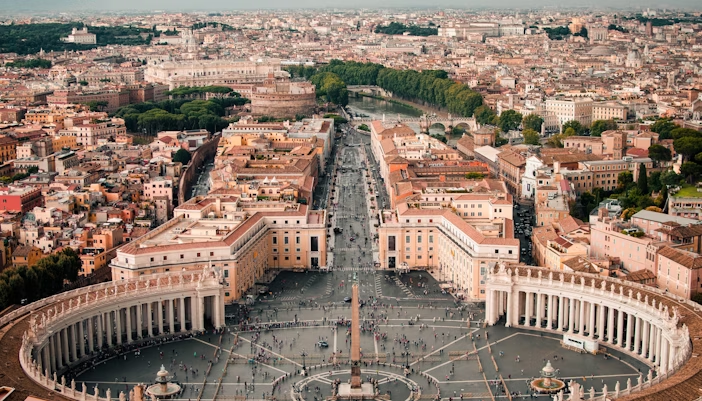
Many people are surprised to learn that the smallest country in the world covers less than half a square kilometer. Vatican City holds this title, covering about 44 hectares.
Despite its small size, Vatican City plays a major role in global religious and cultural affairs. It serves as the spiritual and administrative center for millions of people worldwide and is home to famous landmarks, historic architecture, and priceless works of art.
A Country With More Lakes Than the Rest of the World
Canada is home to an extraordinary number of lakes—more than any other country in the world. In fact, it is estimated that Canada contains more than two million lakes, accounting for a significant percentage of the planet’s freshwater resources.
These lakes range from massive bodies of water to small, remote ponds located deep in forests. This abundance of freshwater plays an important role in Canada’s ecosystem, wildlife habitats, and outdoor recreation.
The Country With the Most Time Zones
France holds the record for having the most time zones of any country. While mainland France operates on a single time zone, its overseas territories are spread across different time zones.
When all territories are included, France has a total of twelve time zones, more than any other nation. This unique fact highlights how global territories can influence a country’s geographical presence.
A Nation Without a Standing Army
Some countries prioritize peaceful policies to such an extent that they do not maintain a permanent military force. Iceland is a well-known example. The country does not have a traditional standing army and instead relies on international cooperation to maintain defense.
Iceland’s approach reflects its strong emphasis on diplomacy and peaceful international relations.
The Country With the Most Islands
Sweden holds the record for the most islands in the world. The country is estimated to have over 260,000 islands scattered along its coastline and lakes.
While most of these islands are uninhabited, many are popular vacation destinations, offering beautiful natural scenery and opportunities for boating, fishing, and outdoor exploration.
The Swedish archipelagos are considered some of the most picturesque coastal regions in Europe.
A Country That Is Entirely Surrounded by Another Country
Some countries exist completely within the borders of another nation. Lesotho, located in southern Africa, is entirely surrounded by South Africa.
This type of country is known as an enclave. Lesotho’s mountainous terrain and unique culture distinguish it from the surrounding regions, making it a fascinating example of how geography shapes national identity.
The World’s Happiest Countries
Several global studies consistently rank certain countries among the happiest in the world. Nordic countries such as Finland, Denmark, and Norway often appear at the top of these rankings.
These nations tend to prioritize social welfare, work-life balance, healthcare, and strong community support systems. Their approach to social policies often contributes to higher levels of life satisfaction among citizens.
The Only Country Named After a Woman
Saint Lucia in the Caribbean is believed to be the only country in the world named after a woman. The island was named after Saint Lucy of Syracuse, a Christian martyr from the 3rd century.
This unique naming tradition sets Saint Lucia apart from other countries and adds an interesting historical dimension to its identity.
A Country Where the Sun Never Sets in Summer
Some countries experience natural phenomena that feel almost magical. In places close to the Arctic Circle, such as Norway and parts of Finland, the sun remains visible for nearly 24 hours during parts of the summer.
This phenomenon, known as the “Midnight Sun,” occurs because of the Earth’s tilt and its position relative to the sun. It creates long, bright days that allow people to enjoy outdoor activities late into the night.
In contrast, these regions also experience very long nights during the winter months.
Conclusion
The world is full of incredible facts that highlight the diversity and uniqueness of different countries. From nations with thousands of islands to places where the sun shines all night, these fascinating details show how geography, culture, and history shape each country in its own way.
Exploring these lesser-known facts not only satisfies curiosity but also deepens our appreciation for the planet’s rich diversity. As we continue to learn about different nations and cultures, we gain a greater understanding of how interconnected and remarkable our world truly is.